
How to read the Tibetan calendar
Elements, animals and special days of the Tibetan calendar, and how to use it calmly, in the light of the Buddha's teachings.
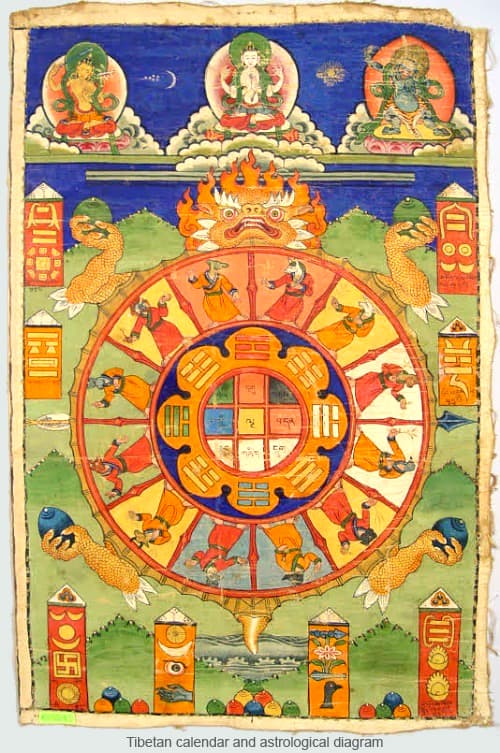
The Tibetan calendar brings together traditional astrological indications: the combination of each day’s elements (earth, water, fire and wind) and lists of activities considered favorable or unfavorable, such as cutting your hair, travelling or starting building work. They are cultural references handed down for centuries that can help us plan with care — not rules to be followed out of fear.
In the Buddha"The Awakened One": a being who has removed every fault and perfected every quality, attaining full enlightenment. In the plural, it refers to all enlightened beings.’s teachings, what most determines the result of our actions is our motivation and the karmaThe law of cause and effect of actions: virtuous actions bring happiness and non-virtuous actions bring suffering, in this life or in future lives. we create. An “unfavorable” day does not make anything forbidden, and a “favorable” day does not replace ethics and kindness. If something important falls on an unfavorable day, go ahead calmly: generate a good motivation, dedicate the action to the benefit of all beings and, if you wish, first do a short practice or mantraSacred syllables recited to protect the mind and connect with the qualities of a Buddha or deity. Associates can record their mantra counts in My Account. recitation.
The most valuable use of the calendar is to remember the special dates — full moon, new moon and the great Buddha days — on which the tradition teaches that virtuous actions have special power. They are wonderful occasions to practise.
- The elements: earth, water, fire and wind describe qualities — stability, fluidity, warmth and movement. The day’s combination crosses the element of the weekday with that of the lunar mansion; the cycle of years also includes wood and iron.
- The twelve animals: Rat, Ox, Tiger, Hare, Dragon, Snake, Horse, Sheep, Monkey, Bird, Dog and Pig mark the years, months and days. Together with the elements they form a 60-year cycle. Many people look at the animal of the day to see how it relates to the animal of their birth year — only as a point of reference.
- Omitted and doubled days: the lunar month does not follow the days of the Western calendar exactly: sometimes a lunar day is skipped (chad, e.g. from the 23rd to the 25th) and sometimes it repeats (lhag, e.g. day 9, 1st and 2nd part).
If in doubt, talk to the members of the sangha.
See our Tibetan calendar on our page, together with the centre’s full schedule of activities, by clicking here.